


Following Federal Funds: An Analysis of Pass-Through Dollars to Nevada’s Nonprofits
Nevada has made real progress in securing more federal grant dollars over the past decade, yet the state continues to receive far less federal funding per resident than most of the country. After ranking 50th in Federal Fiscal Year (FFY) 2014, Nevada climbed to 45th in FFY 2020 before slipping again to 47th in FFY 2023. This persistent gap, combined with a comparatively small state tax base, creates a challenging environment where nonprofits play an outsized role in delivering essential services that depend heavily on federal support.
Across Nevada, nonprofits are core partners in meeting community needs in health, education, housing, and social services. As federal funding streams shift, state and local leaders have increasingly sought clearer visibility into how these dollars move through state agencies and ultimately reach Nevada’s nonprofit sector.
This study builds on the Guinn Center report, Overview of Statewide Federal Funding in Nevada: 2023–2025 Biennium, which mapped the flow of federal dollars into Nevada’s major state agencies. Here, we take the next step by asking:
Where do those federal funds go once they leave the state agency, and how much of them go to Nevada nonprofits?
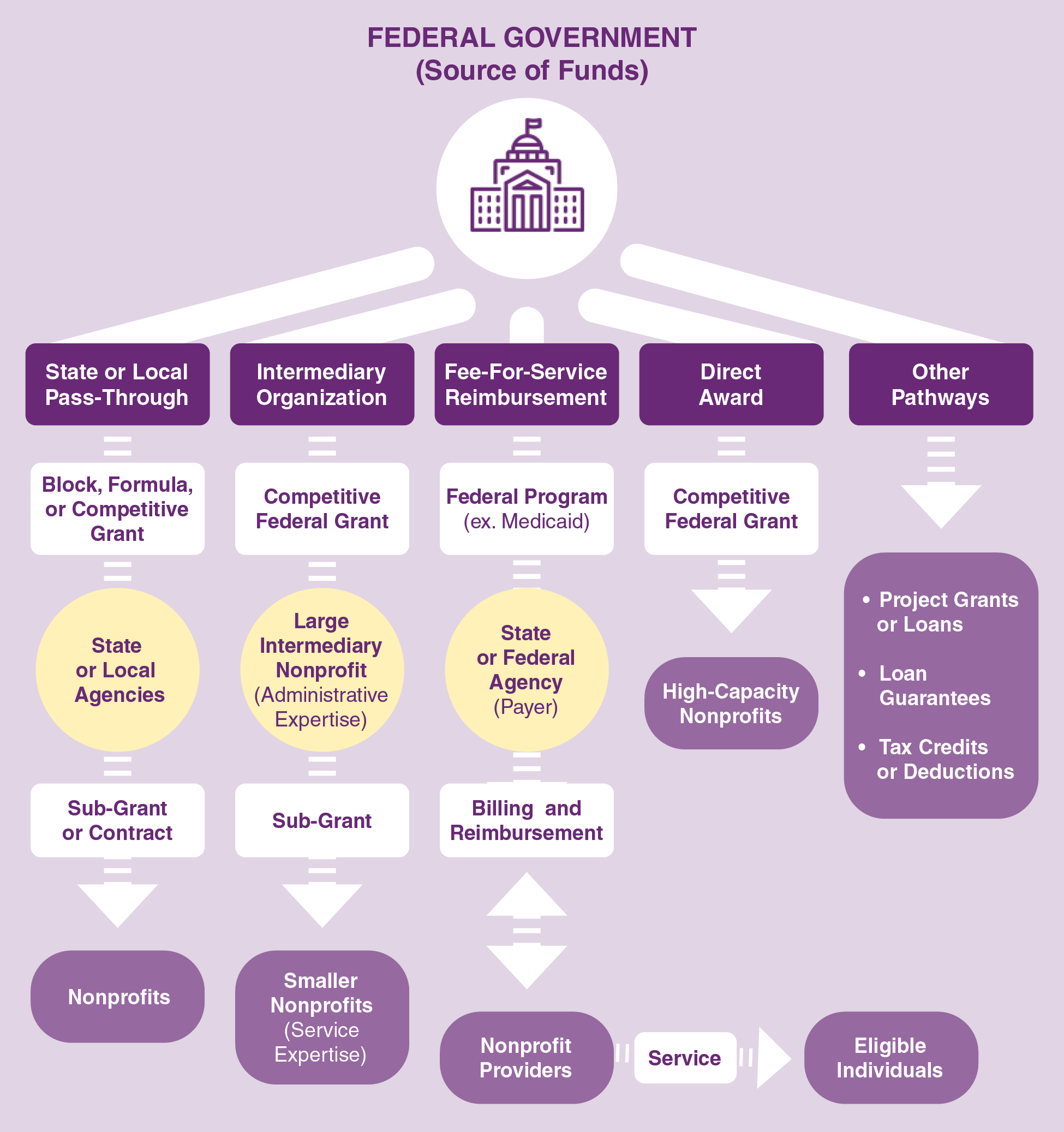
Our analysis focuses on $818 million in federal funding that passed through DHHS, the Department of Education (NDE), and the Department of Agriculture (NDA) in State Fiscal Year (SFY) 2025, examining the first recipients to receive federal pass-through funding from the State. This report offers a snapshot of how federal dollars flow through Nevada’s state agencies and the critical role nonprofits play in turning those dollars into services that strengthen communities statewide.
Key Takeaways
- In Federal Fiscal Year (FFY) 2023, Nevada ranked 47th nationally in federal grant funding, falling short of the national per capita level of $2,779, with Nevada's per capita federal grant funding at $2,192.
- Within the Legislatively Approved Budget for the 2023-2025 biennium, federal funding made up 27.7 percent or about $14.8 billion out of the total $53.4 billion state budget. Of that 27.7 percent, nearly 80 percent went to the Department of Health and Human Services (DHHS), followed by the Department of Transportation (NDOT), the Department of Education (NDE), the Department of Agriculture (NDA), and all other state agencies.
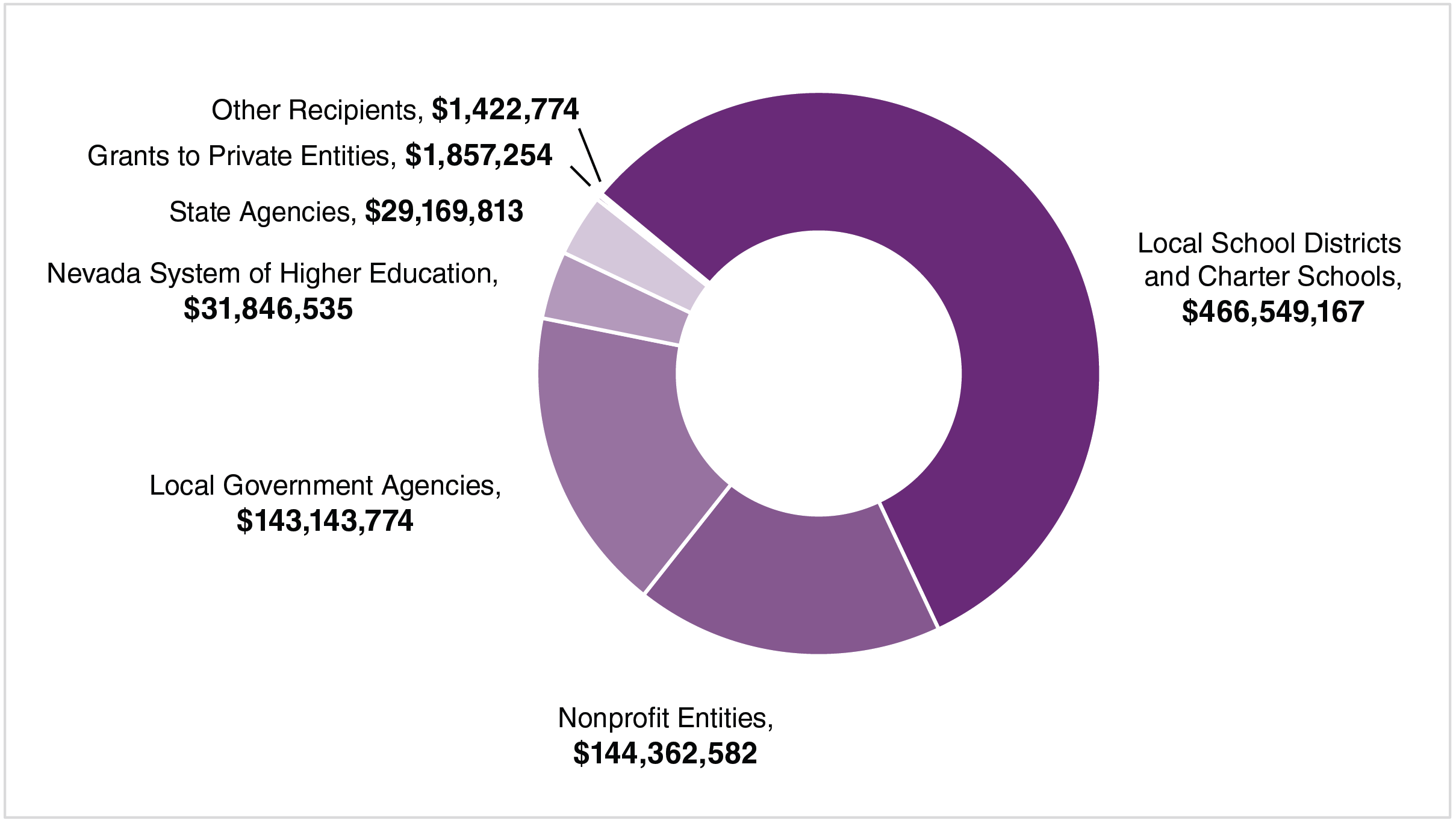
- Of the $818 million in federal funding that passed through the DHHS, NDE, and NDA, 57 percent was transferred to local school districts and charter schools, 17.5 percent to nonprofit entities, 17.5 percent to local government agencies, 4 percent to the Nevada System of Higher Education, 3.5 percent to state agencies, and less than 1 percent to private entities and other recipients.
Policy Considerations
- Investment in Data Infrastructure: Nevada’s limited data infrastructure makes it difficult to understand how federal dollars move through the state, creating a major barrier to policymaking. Without a comprehensive state system for tracking federal dollars from appropriation to final use, lawmakers lack the visibility needed to anticipate risks, respond to federal funding changes, or ensure resources reach the communities and organizations that depend on them.
- Audit of Service Continuity Risks: Nevada’s dependence on federal pass-through dollars, combined with its low per-capita federal funding, creates a fragile foundation for the state’s service delivery system. Can state agencies realistically absorb these responsibilities if nonprofits were forced to scale back or close, or would critical services simply disappear?
- Building Resilient Revenue Streams: Lawmakers may also consider strategies to stabilize essential services as one-time federal resources expire, such as diversifying funding streams, supporting long-term planning, and identifying state-level investments that prevent service disruptions.
For questions or comments about this study, and to receive an ADA-compliant version for the visually impaired, please email us at info@guinncenter.org.