Declining Enrollment: Factors, Trends, and Opportunities

Public schools across the country are grappling with declining enrollment. Public K-12 enrollment dropped sharply in 2020, has been roughly flat since, and is projected to decline 5.5 percent by 2031. In Nevada, the situation is similar: statewide enrollment has fallen 5.4 percent, from a peak of 500,860 students in SY 2019-2020 to 473,657 in SY 2025-2026.
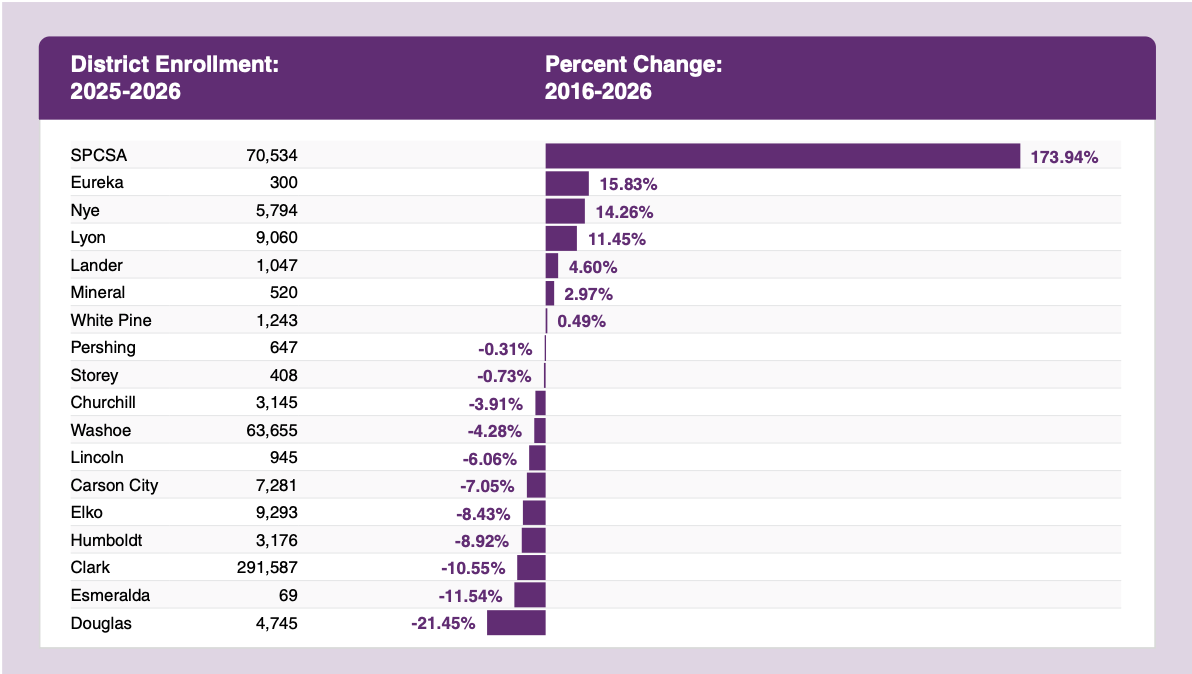
This decline in public school enrollment is not the result of a single factor, but rather of several compounding ones. The largest drivers are:
- Falling birth and fertility rates
- Changing migration patterns, within Nevada and internationally
- Shifts away from traditional public education, such as homeschooling, virtual programs, and private schools
Nevada’s birth rate fell 17.2 percent between 2011 and 2023, far more than the 10.6 percent national decline, and even as the state’s population grows, its number of young children is shrinking.
What our analysis found:
Nearly every Nevada school district outside the State Public Charter School Authority experienced a decline in enrollment this past year. These declines may also carry fiscal and equity consequences. Research shows that high-poverty schools are losing students at nearly double the rate of more affluent schools. As Nevada’s per-pupil spending is almost $3,000 below the national average, the districts under the most acute fiscal stress may also have the least room to adjust.
While declining enrollment poses challenges for districts and policymakers, there may also be opportunities to rethink how schools are structured and how education is supported in our state. Districts and policymakers have considered school consolidations and hold harmless provisions, as well as a potential expansion of pre-K classroom space.
Administrators, district leaders, policymakers, and communities may wish to work together to plan for continued enrollment declines within classrooms and to better understand how these declines will affect higher education and the workforce. As declining enrollment is not unique to Nevada, researchers and policymakers may look to other states to consider how best to navigate sustained enrollment decline.