


What IS the Dignity Index?
Jianna von Savoye, Communications Intern
What does it look like to disagree and still treat one another with dignity? As ravines of division widen across the country, this question is more timely than ever. This year’s Gallagher Dialogues, hosted simultaneously in Reno and Las Vegas on April 2, 2026, grapples with this answer through a statewide discussion with the Dignity Index as its pulse.
“In the last several years, overall, Americans have seen a decline in political rhetoric, in the level of dignity in political rhetoric, campaign finance letters that go out, funding letters, commercials,” said Tami Pyfer, one of the guest speakers at this year’s Gallagher Dialogues. “I mean, we've all seen it so often that I think we've become a little desensitized to it.”
Pyfer sat down with Communications Intern Jianna von Savoye to discuss the upcoming Gallagher Dialogues and the principles of dignity at the core of the discussion. Pyfer is the Chief Impact Officer for UNITE and co-creator of the Dignity Index, an eight-point scale designed to help people think critically about their language and thereby ease divisions. Pyfer’s inspiration for the Dignity Index is rooted in her personal and professional experience, including serving as an elected official for 12 years and working as the Education Policy Advisor to former Utah Governor Gary Herbert. Along with her colleagues, Tim Shriver and Tim Rosshirt, Pyfer brought the Dignity Index framework to life in 2021.
“The combination of being an elected official, working in education, and then working for my governor, really prepared me for this work that we're undertaking now, which is this combination of politics and, in my view, also education,” Pyfer said. “Educating people about this situation we find ourselves in, which a lot of people don't see: the language of contempt.”
Built on philosophical principles and interdisciplinary research in conflict resolution, relationship science, moral development, and human dignity, the Dignity Index brings awareness to the ways we engage those with whom we disagree. Originally developed as a tool to score politicians’ language, Pyfer and UNITE invite everyone to use the Dignity Index in their communications— from public life to everyday interactions.
“We quickly learned that the most powerful use of the index is to score ourselves,” Pyfer said. “Once you begin to see things differently, then you begin to expect dignity from the people who represent you. That's how we hold candidates or politicians accountable.”
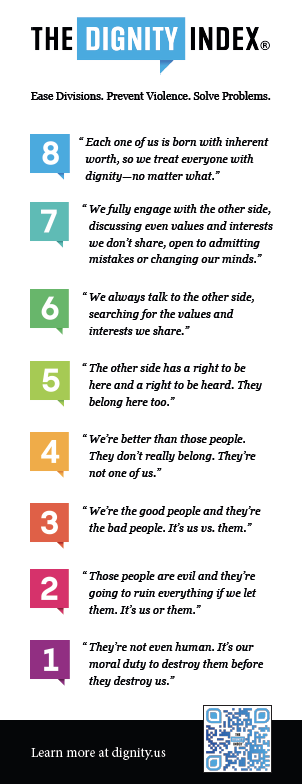
Lower scores on the scale (1–4) indicate a language of contempt that effectively shuts down discussion before problems can be solved and mutual understanding can be reached. At a four on the index, the first step toward contempt, the speaker feels superior to the other. A one on the scale is the most severe and indicates language that escalates toward violence and dehumanization.
“We wanted to use this to score politicians’ language so we could have people look at the candidates and ask who uses contempt? Who uses dignity?” explained Pyfer. “If you have a candidate who uses contempt all the time, chances are they're not going to be a very good problem solver when they get elected, because they're not going to be able to have these conversations.”
On the other side of the scale (5–8), dignity opens up difficult conversations by reinforcing the inherent worth of every human being, bridging divides, and solving problems across the aisle by seeing oneself in the other.
“We want to disagree in a way that doesn't use contempt, that doesn't dehumanize people, that offers people dignity, the benefit of the doubt, curiosity, and humility in our conversations,” explained Pyfer.
From the pilot project that used the Index to evaluate speech in Utah’s 2022 midterm elections, to the National Governors’ Association, to the Communication Studies and Political Science Departments at the University of Nevada, Reno, the Dignity Index has been applied in practical ways in politics, education, and interpersonal relationships.
“To me, the success that we're seeing… is a testament to the hunger that the people in the country have for a better way, a different way,” said Pyfer.
Pyfer will further discuss her work on the Dignity Index and hopes it will help Nevadans move beyond polarization and toward unity. “Changing ourselves helps change the culture because it helps us see things differently and expect more from the people who inform us, who represent us, and who entertain us,” explained Pyfer. “We are thrilled to extend an invitation to be part of the conversation and the change at the Gallagher Dialogues.”
Learn more about the Gallagher Dialogues and purchase tickets here.